
If this turns out to be true, Apple are fucked.
Spotify is amazing.
Spotify and Google Team Up To Take Down iTunes
Spotify is amazing.
Spotify and Google Team Up To Take Down iTunes

AT&T have today announced that they will be launching five new Android devices from Motorola, Dell, and HTC in the first half of 2010.
According to the recently issued press release, the Motorola handset will include the MOTOBLUR user interface along with a "unique form factor". AT&T will also be the first carrier to offer Dell's first Android handset.
Here's the full press release:
AT&T today announced plans to launch five new devices from Dell, HTC and Motorola based on the Android platform. The company also announced a major initiative to expand the universe of mobile applications beyond smartphones to more mobile phones – and spur future app development for emerging consumer electronics devices, its U-verse TV platform, and enterprise and small business workplaces.
At the 4th annual AT&T Developer Summit in Las Vegas, executives outlined details including:
* New devices that will give customers the most robust choices of major operating systems (OS), including Android™, in the U.S.
* A goal to offer all major smartphone OS app stores
* An agreement with Qualcomm to standardize apps development for mid-range Quick Messaging Devices using BREW Mobile Platform. These devices are used by millions of customers who historically have not had the same convenient access as smartphone customers to the market's hottest apps
* A new AT&T SDK (software developer kit) to help developers immediately begin to develop apps for these devices
* A significantly enhanced developer program and new relationships with global carriers that are intended to make it easier for developers to distribute apps in markets outside the U.S.
* Future initiatives to enable developers to create more apps for AT&T's U-verse TV, emerging consumer electronics devices, and businesses
* A new AT&T Virtual Innovation Lab and two new Innovation Centers, which will help developers and spur apps development
"Applications help consumers realize the full value and benefits of mobile broadband networks, services and devices," said Ralph de la Vega, president and CEO, AT&T Mobility and Consumer Markets. "Today some AT&T customers can take advantage of more than 100,000 apps – but only if they have the right handset. Our goal is to bring more apps to millions more of our customers who want convenient access to the market's hottest apps. At the same time, in the future, we plan to go well beyond mobile devices to spur apps development."
In addition to ultimately giving more customers more choices of applications, the long-term strategic initiatives announced today will make it easier for developers to cost effectively create applications and reach broader audiences, and help AT&T drive data revenues.
Extend Smartphone Leadership
AT&T will further its leadership in smartphones with the planned launch of five new devices from Dell, HTC and Motorola based on the Android platform. Those devices, which are scheduled to be available during the first half of 2010, include:
* A Motorola smartphone, powered by MOTOBLUR, with a unique form factor and an AT&T exclusive
* Dell's first smartphone, based on the Android platform and an AT&T exclusive
* A HTC smartphone, based on the Android platform, and an AT&T exclusive
AT&T customers with these devices will benefit not only from the nation's fastest 3G network but also the ability to simultaneously talk on the phone while surfing the Web or reading email. Customers can sign up for email notifications as more details are available at Android Smartphones from Motorola, Dell, and HTC | Wireless from AT&T, formerly Cingular.
In addition, AT&T announced its goal to lead the industry in application choices for smartphone customers by offering all major app stores. It will preload the corresponding store for each device -- giving customers convenient access to thousands of apps optimized for their smartphone. Today, AT&T added to existing agreements with Nokia for Ovi store and Microsoft for Windows Marketplace by announcing an agreement for Android Market. It expects to announce more app store agreements in the near future and will offer carrier billing as an easy and convenient payment option for as many stores as possible.
'Apps for All' by Standardizing Apps Development with Brew Mobile Platform
De la Vega also announced a significant new agreement with Qualcomm to standardize apps development by adopting BREW Mobile Platform. With this agreement, AT&T intends to make BREW Mobile Platform its primary operating system platform for Quick Messaging Devices, one of the company's fastest growing categories of devices.
AT&T customers with these devices historically haven't had the same convenient access as AT&T smartphone customers to thousands of compelling, new applications. Since AT&T launched its pioneering line-up of Quick Messaging Devices in fall 2008, about 30 percent of the company's postpaid customers who are new or upgrading have purchased this type of device. AT&T is committed to spurring innovation and apps development for the millions of customers in this category.
Quick Messaging Devices are integrated devices that are value priced and texting centric; they have full QWERTY keyboards, either physical or virtual, and, since this past fall, full Web browsing capabilities. Customers with these devices are more likely to demand apps, subscribe to messaging and data plans, and are a large potential market for application developers, according to AT&T research.
AT&T Chief Marketing Officer David Christopher announced plans to begin rolling out Quick Messaging Devices with BREW Mobile Platform in the second half of the year, so that by year end 2011, about 90 percent of AT&T's devices in this segment are planned to be based on BREW Mobile Platform. AT&T announced that Samsung will be its first device maker to launch a Quick Messaging Device featuring BREW Mobile Platform. HTC, LG and Pantech also are building devices featuring BREW Mobile Platform for planned availability in late 2010 or early 2011.
"Today, developers must essentially rebuild apps for different handsets and operating systems, increasing their costs, slowing the pace of innovation and stalling the delivery of mobile apps to customers," Christopher said. "We want to tear down the barriers and make it much easier for developers to reach our customers – and for our customers to access apps. Moving to one platform for this fast growing segment of devices will help developers reach millions more customers who want easy access to the hottest mobile apps."
To help developers jumpstart apps development for AT&T's BREW Mobile Platform devices, Christopher announced a new AT&T SDK which features support for BREW Mobile Platform, continued support for Java and widgets, and includes tools to help developers tap into AT&T network capabilities as they design and code their applications. The new AT&T SDK is available starting today at sdk.developer.att.com.
Taking the AT&T Developer Program to the Next Level
AT&T has a longstanding commitment to the developer community. It was among the first major carriers to offer a developer program and has been rated the top carrier development program for the past three years by Evans Data. Today, AT&T executives also announced plans, including some launch schedules, for a series of new or enhanced developer resources including:
Technical support for developers via live chat -- something no other carrier, operating system provider or handset maker offers today – and a tripling of overall tech support by mid-2010.
* Revenue share featuring a standardized 70/30 split for third-party developers in the AT&T App Center.
* AT&T Sandbox, a virtual network environment for developers to test and evaluate applications, which is planned to be available in 2Q 2010.
* AT&T Developer Dashboard, a tool that will let developers track the status of their app once submitted to AT&T, support digital signing of business agreements with AT&T, allow developers to set prices for their apps, and provide performance metrics and customer satisfaction feedback. The dashboard is available now for enterprise application developers and the certification of emerging devices. And for AT&T's consumer development community, the dashboard will also provide needed automation which is planned for the first quarter of 2010.
* New marketing and referral relationships announced today between AT&T and other global carriers using GSM, the de facto world standard for wireless technology. The companies intend to create streamlined processes that help developers make their applications available to their combined base of hundreds of millions of customers.
* AT&T Developer Council, an advisory group hosted by AT&T and made up of leading development and technology companies and other influencers, such as EA Games, Telenav and Bonfire Media.
AT&T also announced a trial program with WaveMarket to make network location information accessible through Veriplace, WaveMarket's cloud location aggregation platform currently in use by more than 1,000 developers. Veriplace allows SMS, Web, WAP and IVR developers to develop location-aware apps and services across device categories and participating carriers. The trial program will launch in the coming weeks.
AT&T Chief Technology Officer John Donovan also said that a new AT&T Virtual Innovation Lab will open in Atlanta in the second quarter to provide developer support for speech, location and messaging APIs (application programming interfaces). In addition, two new Innovation Centers, one in the East and one in the West, are planned for late 2010 to provide 3G and 4G RF (radio frequency) development support, testing and demos.

So, what's the verdict on the Nexus One?

The Sony Ericsson has a similar design to the Xperia X10 but is a much smaller handset in comparison. Little is currently known about the handset but it is believed to be available in a variety of colors and will feature a touchscreen display, 5 mega-pixel camera (with autofocus), 3.5mm audio jack, usb connectivity, and HSPA/WLAN.

HP showed off an Android-powered smartbook tonight that was running on the Snapdragon platform. We lit the HP rep up with endless questions, but all he could tell us was “It’s a tech demo”.
We were lucky enough to hold the device and play with it, but the rep didn’t want us checking the settings to see which version of Android it was running. Based on the icons we saw on the desktop, this device was definitely running a custom version of Android 1.5 or 1.6 (but not 2.0).
The only details that were shared about the device were its 10 inch resistive touch screen and weight of 2.2 lbs.
In my short time with the HP smartbook, I would say it is leaps and bounds above any Android tablet/netbook/smartbook. The device featured a completely custom UI that was tailor made by HP. The keyboard also included Android specific buttons for search, menu, and back.
Since this was only a tech demo HP would not comment on pricing or availability, but I have a feeling we will see it launched with a 3G chipset and supported by a United States carrier.

Lenovo gave us a chance to check out their latest smartphone today at CES 2010. It’s Android-based with a complete facelift and hardly any of the original OS sticking out. I doubt they intended it to be, but it seems like a sort of interesting mix of webOS, iPhone, and Android features. I quite liked it.
Apologies for the noise in the video above, it was captured in an incredibly crowded area. But you get the gist. Just cruise through and check out the screens and animations.
In shape it’s quite pleasing, a little big, but with a good heft and solid feel. The screen is a gorgeous 3.7″ 800×480 OLED one, although I couldn’t confirm whether it’s the same that’s in the Nexus One. It’s got volume buttons on the left side, there, and a reprogrammable button on the right. It’s got a Pre-like dark area at the bottom that’s also touch-sensitive, and works as either a home button or for simple swiping gestures.
The OS is Android, and should be 2.0 at launch, though they declined to say when that might be. It’s completely skinned, though — Lenovo has it equipped with a sort of dual mode home screen, with one (the flower) being a contact jump-off point: you scroll through your contacts and then can pick a petal to message, call, or whatever. It’ll work if you can choose which contacts are included in that scrolling list, but if you have a couple hundred it’ll get confusing mighty fast. The other home screen is a series of widgets, they call it Widget Space, with stuff like weather, stocks, latest emails, that sort of thing.
It’s got the usual fixins: GPS, Bluetooth, Wi-Fi and all that, and it’s running on a Snapdragon processor, though I couldn’t seem to suss out the RAM or internal storage. We’ll hear more about that soon. The lady I spoke with had been using it as her phone for a good two months, so this is definitely final hardware apart from any radio bits to conform it to certain networks.
Forgot to rotate some of these shots; sorry about that. There’s also media playback and all that — there was a little screen for selecting streaming TV channels or what appeared to be some pre-prepared content, movie trailers and such. The apps “drawer” is now a series of pages, like iPhone apps. It’s a proven technique, though of course slightly derivative.
There’s a connector on the left side with a cover that attaches magnetically (Clever? Yes. Dangerous? Also yes.). It lets the Lephone connect to what is envisioned as a series of peripherals, the first you see here:

Yes, it’s a keyboard. I gave it a shot and it seemed to work just fine, although the key layout is tweaked in a slightly weird way. But it worked normally and actually closed up to form a large clamshell you could carry around.
From what I was told, the plan is to release the device in China first, then expand to the US. There were no carriers mentioned, and they were still working that out for China, so I wouldn’t even speculate just yet. But I was impressed by the phone and the complete little ecosystem they had going. I love me some Lenovo, and it looks like they know what they’re doing.
Here are the rest of the pictures: size comparison, other screens, and the usual glamour shots.

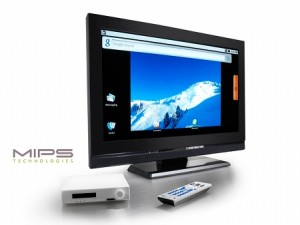
MIPS Technologies has announced, from CES, the capabilities to run set top boxes, Blu ray DVD players, and others on an Android platform. We showed you the other day that Android will soon be capable of running various appliances.
Western Mediabridge Inc. and Sigma Designs will demonstrate the first Android set top box at CES with such capabilities as video-on-demand, Word, Spreadsheet, Slide Show Presentation viewer software, web browser, all while maintaining a clear crisp 1080p video quality.
“With Sigma Designs’ and MIPS Technologies’ industry-leading performance and Android’s open and flexible platform, our Android-based STB is one of the most innovative STB solutions in the market. We anticipate there will be a lot of Android-based products and applications in the near future which will be connected to each other. Our belief is that the Android set-top box will be positioned as a main device among in-home Android-based multimedia devices. We will continue to add more applications, making a more feature-rich Android set-top box,” said Ernest Bang, president and CEO of Western Mediabridge Inc.
I don’t know about you but being able to surf the web, watch tv, and post to Phandroid all from the comfort of my sofa in my sweatpants sounds great to me!

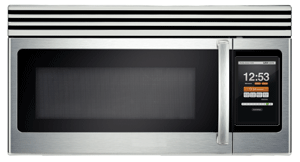
This has to be one of my favorite Android stories from CES. An Android Washer and Dryer. An Android Microwave that runs Pandora Radio. An Android Printer/Copier/Scanner. An Android Desk Phone. And much, much more to come.
Almost exactly one year ago we told you about a company called Touch Revolution as they announced their Android-based NIMble Desk Phone. Mark Hamblin – CEO of Touch Revoluion – foresaw a movement where appliances and other office/home/mobile electronics could greatly benefit from the use of a touchscreen with integrated capabilities. Android was a vehicle to bring that vision to life and at CES they displayed their ability to do just that:
Popout
In terms of Android hardware, “outside the box” seems restricted to manufacturing tablets, netbooks and eReaders with Android slapped on. But home appliances integrated with a custom version of Android designed to meet the goals of that particular device? Very cool.
Touch Revolution doesn’t manufacture appliances themselves and do not sell finished products directly to consumers through retail channels. Instead, OEMs (Original Equiment Manufacturers) will come to them with an existing product (washer/dryer, microwave, coffee pot, etc…) and say hey, we like our product but would love it if it had a touchscreen and some added capabilities.
Added capabilities could be simple as you saw with the Printer and Washer/Dryer in the video – you wouldn’t even know those were Android-based because you’re restricted to using functions focused ONLY on the main directive of printing or washing/drying. This is interesting in and of itself that the free and open nature of Android allows Touch Revolution to bring an amazing touchscreen experience to its customers without having to rebuild the wheel. But looking up maps or coupons ON your printer and resizing and getting print previews using your fingers on the printer’s touchscreen itself? I’d say that’s a step forward.
Then there is the microwave which actually runs a FULL version of Android directly on the touchscreen panel. It probably isn’t necessary as the CEO admits, but it goes to show the company can take any existing product and integrate a wide range of experiences through Android – it just depends what type of experience you want to accomplish.
Right now EVERY product Touch Revolution works with utilizes the same solution – the NIM1000 NIMble Module – a 7-inch capacitive LCD touchscreen with Wi-Fi, USB 2.0, Bluetooth and more. They take this one “board” and integrate it as they see fit. While I’m guessing they’ll produce other sizes/combinations in the future, the 7-inch solution provides enough capabilities and has enough flexibility to serve a wide range of purposes.
One unexploited opportunity I see with Android is the use of Bluetooth APIs. I asked Mr. Hamblin if certain devices/appliances might have an Android Application component so you could control said device with your Android-based smartphone. He noted the possibility but this clearly wasn’t a focus. What IS the focus? Accomplishing whatever goals his partner’s have outlined.
I can tell you right now if I was a forward-thinking company who produced any type of appliances, home electronics, etc… I would be calling Touch Revolution to get the ball rolling. If I was a Venture Capitalist or had more money than I knew what to do with I would start dreaming up unique and interesting ways to integrate Android with existing, traditional electronics in non-traditional and more exciting ways.
The interesting thing about all of this to me is that while Touch Revolution is operating outside of the box they’re doing it in such a way that it seems logical and inside the box. It just makes sense. Hamblin says the company is already working with microwave and washer/dryer manufacturers to bring their solutions to the masses and I couldn’t be more excited to see how they fare and watch Touch Revolution continue to churn out Android-based solutions.
Hamblin suggested that medical devices could be a HUGE industry to benefit from Android integration and they note remote controls, portable kiosks and other appliances as up-and-comers as well. Where would YOU most like to see the companies solutions embedded in your everyday life? Or are you scared some enterprising serial entrepreneur is reading these comments waiting to hop on the opportunity of a lifetime?

Cydle's M7 isn't the best tablet we've seen this year. In fact, it's hardly even a tablet -- it has a built-in stand that allows it to stand at attention in either landscape or portrait mode. When not in use, the stand actually flips around and acts as a screen cover -- which is a little comforting when thinking about this soft 7-inch resistive touchscreen bumping against sundry objects in a laptop bag. The Android software on the device right now is ultra beta, so we weren't able to see the internal ATSC TV tuner in action, but it does set the $199 device apart from some of its slate brethren, though our favorite feature might actually be the simple ability to use this device as an extra PC monitor. You know... it's the little things in life. Under the hood there's an ARM11 processor at 800MHz. The M7 should be launching in the Spring, and you can check out some video of the unit after the break if you're into that sort of thing.


